|
|
7 April 2020
Senator
the Honourable Eric Abetz
Senator for Tasmania
Dear Senator Abetz,
Seafarers and COVID -19In
the particularly trying circumstance of managing the nuances presented
by COVID-19 on the maritime industry, the Cruise Ship sector has
demonstrated resilience, adaptability and compassion when dealing with
the affects of the pandemic on valued guests and crew. Maritime
professionals have watched the COVID-19 situation shift the public’s
perception of the cruise ship maritime sector from one of tourism and
adventure to that of fear, chaos and demonisation of the sector.
Despite this, the cruise ship sector has kept abreast of circumstances
by seeking advice from shipping agents and respective Company
authorities working with Federal and State Governments. This advice is
underpinned by the International Maritime Organisation’s (IMO) regular
COVID – 19 updates, and the World Health Organisation’s guidance on
the management of health issues for shipping. Cruise ship companies
operate to very high public health standards that consistently exceed
those required ashore. Long term relationships with Australian
Government health officials and Australian Border Force have built
trust that these companies, and the vessels they operate, comply with
the law and meet the expectations of modern social standards.
The crew of commercial ships, including cruise ships, are of many
different nationalities employed under the Maritime Labour Convention
(MLC) to which Australia is a signatory. With the current border
closures on a global scale, ships and crews need, more than ever, a
port of refuge.
The Secretary General of the IMO has
called for a pragmatic approach in these unusual times. While the
recent focus has been on a specific element of the maritime industry,
cruise ships, it is important to recognise that maritime transport is
also fundamental to the supply of goods worldwide and carries
approximately 98% of Australia’s trade. It is vital that maritime
cargo and supply chains are not disrupted such that global trade
continues throughout the pandemic with minimal impact on seafarers.
IMO COVID-19 guidance is regularly updated to facilitate this global
trade dynamic; for example, Circular Letter No. 4204/Add.6, issued on
27 March 2020 (www.imo.org)
Seafarers recognise that the perception of the maritime domain has
been largely shaped by the engagement of thousands of passengers
travelling around the Australian Coast and further, in cruise ships.
Seafarers on cruise ships currently drifting off the Australian coast
also recognise that, through media reporting, their ships have become
the subject, and cause, of fear and anxiety relating to the Pandemic.
Like circumstance ashore, seafarer concern now turns to a keen desire
to diligently ensure that full measure is taken to reduce the impact
of COVID-19 on those still assigned to cruise ships drifting off the
Australian Coast.
The Nautical Institute (NI) is an international organisation for
maritime professionals. Its membership encompasses a broad range of
experience across the maritime spectrum including Ship Masters (cruise
and cargo sectors), maritime lawyers, marine pilots, Harbour Masters,
Academics and Naval personnel. The NI is an NGO with consultative
status at the IMO and regularly works with the global community,
including Australia, on key maritime issues. It is an internationally
acclaimed source of maritime expertise and a potentially valuable
resource for governments and the public service. Australia has four NI
Branches with maritime experts available to provide advice on maritime
issues, especially during these unique and testing circumstances.
Australian NI Branches are requesting that those making decisions and
issuing
Directives that impact on seafarers, especially those in the cruise
ship sector, focus their decisions based on an understanding and
empathy for the seafarers’ contemporary circumstance dealing with the
chaos that is
COVID-19.
If professional maritime expertise is required, please contact me for
further details of NI maritime professionals.
Yours Sincerely,
Captain Peter Martin FNI, CMMA, AIN
Master Mariner, Commander RAN
Nautical Institute Councillor – Tasmania Representative PhD Candidate
National Centre for Ports and Shipping
University of Tasmania / Australian Maritime College
https://www.linkedin.com/in/capt-peter-martin-fni-06629525
pinchj@bigpond.com
+61 428 073 229 |
12 February
2020
South
East Australia Nautical Institute Branch Quarterly meeting –
Sydney 12 Feb 2020.
Presentation – Smart Ships: Smart Ports
Presenter – Capt. Rob Tanner AFNI, Senior Pilot, Port Kembla, NSW.
Report: Rob began the presentation going
back to 1974 to one of his first ships MV British Cormorant with 42
crew onboard and compared it to a current regular visitor to Port
Kembla, NYK’s car carrier ‘MV Iris Leader’.
The modern-day vessel has a
complement of 20 and the only thing the two ships really have in
common would be the radar and the autopilot. |
.jpg)
Kendall Carter Branch
Secretary
(left) and Rob Tanner AFNI
|
MV Iris Leader is one of the world’s first vessels trialling
autonomous operations, and last year sailed for around 6 hours
autonomously from China to Japan. Rob reckons “this is the way of
things to come” and all this has to do with the change of pace in
technology.
Last year Rob attended an Autonomous Ship Technology Conference in
Amsterdam. The presentations mostly related to current and emerging
shipboard technology and that humans will be replaced by that
technology. Humans were held to be superfluous as they are, it is
alleged, the root cause of most shipboard incidents. Maritime
Autonomous Surface Ships (MASS) ship owners would not have to consider
any safety provisions or hotel services allowing more cargo space to
be available. This stimulated his thinking to explore what skills and
knowledge seafarers would need in the future and how the maritime
industry will address those skills and knowledge requirements.
Some of the major presentations were on vision technology where they
talked about Lidar (Light detection and ranging) and 360 deg thermal
camera imaging, which are then processed and fused with radar and
ECDIS inputs to provide options for multi target tracking and
predictions for collision avoidance.
Cyber security, a major topic, ensures that control of the vessel is
never lost and access to GPS is continuous and secure. To prevent
cyber-attacks a possible solution is to have Information &
Communication Technologies (ICT) trained humans, and authenticated
access to protect against system entry by cyber pirates.
Another topic discussed by ship brokers and maritime lawyers was on
the liability of MASS. Some said that the liability would lay with the
remote operator, or for level 4 MASS v/ls which are totally unmanned
it could be with the shipowner / operator or software engineers.
Another interesting point is at this time there is no legal definition
of what an Autonomous v/l is.
A speaker from an oil major made a bold statement “we need to get rid
of the bits of string”; of course referring to mooring lines on
vessels. Mooring lines cause injuries and deaths far too often and in
the interest of safety should be replaced with mooring devices such as
suction or magnetic mooring fender systems. Which got Rob thinking
“that smart ships of the future will require smart seafarers & smart
ports”.
What is a Smart Port? A Smart Port is one that uses automation and
innovative technologies including Artificial Intelligence (AI), Big
Data, Internet of Things (IoT) and Blockchain to improve its
performance.
All these are new technologies that will lead us to a brighter and
connected future. The need for smart ports is more relevant today than
ever. Ships are getting bigger, goods are moving faster and
geo-political conflicts and pandemics such as Covid -19 create new
challenges for ports to deal with all around the world.
In a conversation that Rob had with Jillian Carson Jackson (Senior VP
Nautical Institute) on the topic, Jillian made some very valid
comments “that we need to investigate shipping lanes and controlled
water space, digital communications and its associated data collection
and the legal framework to underpin the innovation.”
Yara Birkeland – this year will see Norwegian owned and operated fully
electric powered zero emission autonomous feeder vessel ‘Yara
Birkeland’ commence operations in Norway. It will cut down 40,000 long
distance truck journeys and has auto-mooring equipment which requires
no manual handling. Initially the vessel will be manned, until
everyone is satisfied that unmanned operations are safe to continue.
The ship will revolutionise supply chain transport in Norway and the
commercial template may very well start a new supply chain logistics
task in Australia. The arrival of an autonomous vessel at an
Australian port may be sooner than everyone thinks, and we have to
start preparing for it.
What is autonomy? Rob talked about when mentioning autonomous ships,
it must be emphasised that it’s not necessarily talking about just
unmanned vessels and that many people misunderstand what the meaning
of autonomy is. It can be manned, but everything onboard can be
automated. Autonomy is said to be a process rather than an end in
itself. A journey towards increased or full automation of a system and
the reason to introduce autonomy is to improve systems performance.
Increased autonomy is thought to be interconnected with less
environmentally damaging emissions, increased efficiency and safety.
Humans will support the autonomous onboard system with the likelihood
of decreased incidents due to human error. With this in mind a human
centred approach is required when considering the design of shipboard
systems, so that people and machine can work together as a team.
A recent report from the World Maritime University in Norway looked at
how automation and technology will affect the future workforce. The
report said that the process will be evolutionary, rather than
revolutionary. The transport sector will become more efficient as more
automation is introduced, which will lead to improved productivity.
The transport volume is expected to increase into the future, with a
projected need for more transport workers.
Australian ship and port operators need to engage with the vision and
prepare for the future by observing what is happening elsewhere in the
world and learn from their experiences. As Rob says smart ships will
require smart ports. One example of a smart port operation is Searoad
Shipping in their Melbourne and Tasmanian port operations where they
introduced a mooring system that didn’t involve mooring lines, which
has greatly increased safety and efficiency into their operation.
Australia has the 5th largest shipping task in the world, and a few
years ago it was reported that the maritime sector contributed
approximately $20 billion to the national economy annually. Foreign
flag ships carry nearly all of the 98% of goods coming into and out of
Australia, and yet we do not have a domestic fleet of any
significance.
A possible future for our island continent is to use the ‘Blue
Highway’ that surrounds us with small manoeuvrable zero emissions
ships. These would reduce bottlenecks in our major ports, reduce
traffic congestion and pollution around major cities by taking many
thousands of trucks off the roads, and encouraging us to become more
efficient and environmentally sustainable.
Rob realises that there is a clear gap in the important understanding
of how humans will need to be involved with autonomous ships and smart
ports as we look ahead. This has provoked Rob to ask the question;
What is the future of Australian ports and shipping and how do we
build and maintain the necessary knowledge and skills for the humans
in the loop?
Capt. Patrick Walsh AFNI.
Assist Secretary SE Australia NI. |
6 October 2019
Development of Active Tug Escort for Tanker Operations
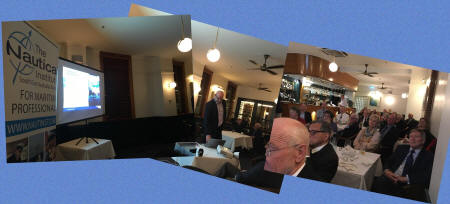
August’s meeting was held in Sydney jointly with the Company of
Master Mariners of Australia and the Australian Institute of
Navigation. Captain Scott Clinton of the Port Authority of New
South Wales gave an overview of how Active Tug Escort procedures
have been recently developed for use in the port of Newcastle in
New South Wales. Scott is a senior check pilot at the port and
has been instrumental in developing and implementing the use of
tugs for tanker operations in and out of the port.
Newcastle port is the world’s leading coal export port,
exporting over 160 million tonnes per year and is very
experienced in handling large Capsize bulk carriers of about
300m length and 50m beam which arrive in ballast and depart
fully laden. Recently however it has been expecting more visits
by petroleum tankers, particularly LR2 type tankers in the
80,000 – 120,000 DWT range of up to 245m in length, 42m beam and
13.5m draft. These arrive fully laden at the very exposed
entrance to the river port and the challenge has been to
mitigate the risks involved in moving them into and out of the
port. The current passive escort procedures needed review.
A full risk assessment was conducted using simulators, and
mathematical models of swell conditions were made. Designated
tracks were designed for certain common swell conditions and a
limit established. Active escort tugs can deploy rapidly to
assist as a contingency for turning and braking and are a proven
method of mitigating risk in the event of shipboard failures.
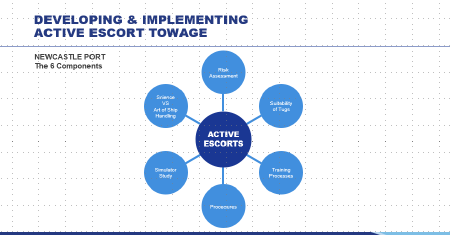
Scott explained the six features which combined to take the
guesswork out of using active escort tugs – Risk Assessment, Tug
Suitability, Training Processes, Procedures, Simulator study,
and the use of science rather than the “art” of ship handling.
His main message was, “We don’t guess!”
He explained there was a large amount of information available
especially concerning wind and swell effects on an exposed hull,
the engine output in tonnes at the propeller and the rudder lift
forces.
It was possible, for example, to model the forces involved if a
ship’s rudder failed and locked hard over and thus know what tug
forces were needed to counter this type of event.
Simulation studies showed that LR2 ship models could be
effectively handled at the port entrance subject to sea and
weather limits. The entry conditions were also limited by under
keel clearance. It was also vital that the tugs used had a
render recovery type winch and the ship’s bits were OCIMF
compliant.
Scott then went on to discuss the type of tugs suitable for this
kind of active escort and how they are positioned and also
explained that communication procedures were also reviewed,
moving to Outcome Based Orders where the pilot is using the
expertise of the tug master to achieve the desired outcome, for
example: - Pilot: “Stern to Starboard full” ; Tug Master: “Stern
to Starboard Full – Indirect”.
He also explained the comprehensive training regime implemented
for the pilots to achieve active escort and how the results had
been very good.
This was a thoroughly engrossing presentation which was enjoyed
by all and the ensuing Q&A period showed the interest generated.
Scott was introduced and thanked by the new Chair of the SE
Australia Branch, Kit Rynd FNI.
Kendall Carter AFNI
|
|
Friday 04
October 2019 Women in
Maritime (WiM), The Nautical Institute SE Australia Branch -
Breakfast Networking & Panel Discussion Tuesday, 29th Oct,
Doltone House, Sydney.
Click here for Flyer
Kindly supported by The Australasian Marine Pilots Institute (AMPI),
in conjunction with the AMPI2019 Pilotage and Port Logistics
Conference and sponsored by Svitzer Australia.
Time is running out to book your place at the breakfast event of
the year! The SE Australia NI Branch is hosting a breakfast
event. ‘Empowering Women in Maritime – a panel discussion’,
which aligns with IMO’s World Maritime Day theme for 2019.
Participants will have an opportunity to discuss what we can do
together to increase participation of women in ports and harbour
maritime roles in Australia. Our keynote speaker Mrs Henriette
H. Thygesen, Svitzer CEO is one of the most respected
professionals in the maritime industry internationally.
Henriette will be joined by Kirsteen Roberts, Second Mate,
Solstad Offshore; Mike Gallacher, CEO Ports Australia and Capt.
Craig Eastaugh, Marine Pilot-Port Hedland & AMPI board member in
the panel discussion.
This will be a sell-out event so please book ASAP to avoid
disappointment using the following link
https://www.ampi.org.au/event-3357934 see attached
flyer for breakfast details and contact me by email
pawalshe@hotmail.com
or mobile 0437681277 for NI and WISTA members discount code.
Attendees to the breakfast are also offered a special rate one
day pass to the conference with some extremely interesting
presentations promised. The highlight presentations are listed
below;
• Pathway to Highly Reliable Pilotage and Port Operations. –
Capt. Jeanine Drummond Harbour Master Newcastle and Yamba
• The Management of Safety in Flight Operations – Capt. Debbie
Slade (Qantas)
• Challenges for the Pilotage Industry in the Age of Big Data –
Capt. Ravi Nijjer
• Evidence Based Training – Captain Simon Henderson Phd
• Risk Assessment versus Due Diligence in Marine Pilotage -
Presented By Richard Robinson
• Shifting Legal Landscape of Marine Pilotage – Ambrose
Rajadurai
• Lessons From UKC Management – Meg Batchelor, OMC
International.
Please feel free to share this email with anyone you think might
be interested in the event.
Best regards,
Capt. Patrick Walsh AFNI
Assist Secretary SE Australia NI branch.
Join the SE Australia NI branch Group page on LinkedIn for the
latest branch news and updates
https://www.linkedin.com/groups/13746709/ |
Friday 13 September 2019
The International Harbour Masters’ Association (IHMA) has
invited the Nautical Institute (NI) to become an official
endorsing partner of the 12th biennial IHMA Congress that is
being held in Hobart on the 23-26 March, 2020. The 2020 Congress
is proudly co-hosted by Tasports and the Australian Maritime
College (AMC) and will explore the theme, ‘The Next Wave –
Navigating Towards the Digital Future’.
The prestigious IHMA Congress is held every two years and
features a three-day conference & exhibition, a technical site
tour and exciting networking and social program. The 2020
Papers’ Committee is developing a stimulating and thought
provoking programme to explore and identify how ports and port
operations, including Harbour Masters and port customers, will
navigate the digital future.
In order to engage with and attract the next generation of
industry leaders, the IHMA has introduced a new 50% discount for
young professionals and will be launching the inaugural ‘Young
Maritime Professionals Pitching Competition’ at the 2020
Congress. Both opportunities are available to all maritime
professionals aged 35yrs and under across the sector. |
[TOP] |
|